

Bitcoin is trading at around $66,600 at time of writing, after slipping over the past week. Economic uncertainty and global tension have made investors more careful, but new data shared by CryptoQuant suggests something else may be happening beneath the surface. The market may be cooling down and slowly moving toward a bottom, which is the area where price stops falling and starts to stabilize.
Good to Know
- Lower Bitcoin fees usually mean fewer people are using the network right now.
- Less speculation can help the market settle after a volatile stretch.
- A calmer market can come before recovery, but it can also come before one more drop.
Less Trading Frenzy Could Help Bitcoin Stabilize
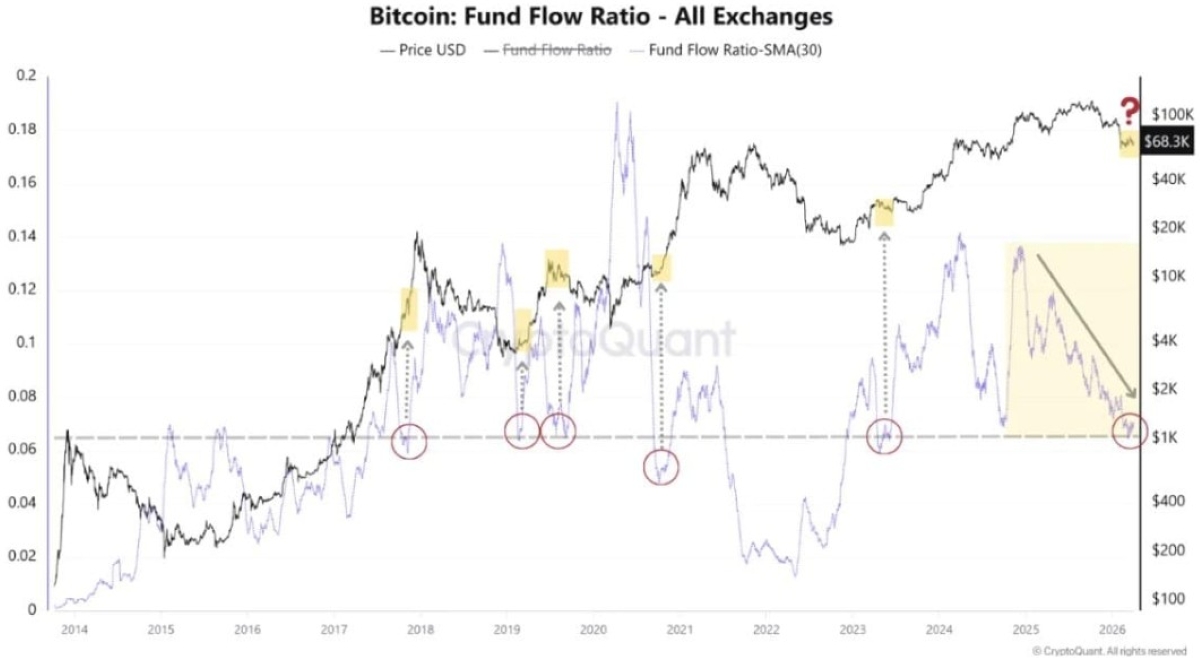
One metric getting attention is the Fund Flow Ratio. It compares activity on the Bitcoin network with the amount of Bitcoin moving in and out of exchanges.
Right now, that ratio sits near 0.065, according to CryptoQuant. The number may sound technical, but the main point is simple. Bitcoin has often started to calm down around levels like that. Similar setups showed up in 2018, 2019, 2020, and 2023, and those periods often lined up with turning points in the market.
What does that tell us? Usually, it points to less fast trading and less short-term speculation. Speculation means traders are chasing quick price moves rather than building longer-term positions. When that activity fades, the market often becomes more stable.
That kind of stability can help create the base for a future recovery. Still, there is a catch. If the Fund Flow Ratio keeps falling, it could point to more selling pressure ahead. In that case, Bitcoin may still have room to move lower before finding firmer support.
Low Fees Show the Network Has Gone Quiet
Another signal stands out. The cost of making a Bitcoin transaction has dropped to its lowest level in six years.
Lower fees may sound positive at first, but they mainly show that network activity has slowed. When fewer people send Bitcoin, demand for block space drops, and fees fall with it. Block space is the limited room available in each block for transactions. When demand for that space falls, the network gets cheaper to use.
A similar setup appeared in 2022. Later on, Bitcoin did recover. So low fees do not automatically mean more weakness is coming. Instead, they can reflect a market that is cooling off before its next larger move.
For now, the data points to a market looking for balance. Less speculation and lower transaction fees can bring some calm, and that phase has often come before a stronger move later. If current levels hold, the odds of stabilization improve. The next big step higher, though, will likely need demand to return in a clearer way.
That also fits the broader market picture from how Bitcoin reacted to Trump’s Iran speech on Thursday. Even after oil jumped and global markets turned more cautious, Bitcoin has remained relatively stable above $66,000 so far. That resilience looks encouraging, but only for now. If wider market stress builds again, Bitcoin could still face a tougher test.