

President Trump on April 1 shifted the tone across global markets very quickly. After he signaled stronger military action toward Iran over the next two to three weeks, investors pulled back from riskier assets. Oil moved sharply higher, the dollar strengthened, and traders began pricing in tighter financial conditions. According to analysis from our colleagues at CryptoQuant, Bitcoin felt that pressure too, even though it has not broken down in a major way yet.
Important to Know
- Bitcoin often weakens when investors move money into cash and safer assets.
- Higher oil prices can add inflation pressure and make markets more nervous.
- Futures leverage can make Bitcoin drops faster than many people expect.
Markets reacted right away after the speech. In the United States, the S&P 500 closed down 0.23% and the Dow lost 0.39% after falling during the day. In Asia, the move was much sharper. Korea’s KOSPI dropped 4.2%, while MSCI Emerging Asia fell 2.3%. At the same time, WTI crude jumped 11.41% to $111, the dollar index added 0.48%, and USD/JPY climbed to 159.
Bitcoin does not trade on crypto news alone. It also reacts to the way money moves across global markets. Oil prices climbed again after Trump made clear that Washington was not aiming for a quick de-escalation. Instead, markets heard a threat of a wider conflict with Iran. On Thursday, oil briefly traded above $110 per barrel after the speech.
When oil rises, investors often worry that inflation could stay high or move higher again. Inflation means prices across the economy keep rising, which can reduce buying power and keep pressure on interest rates. If investors think inflation will stay sticky, they often become more cautious with assets like stocks and Bitcoin.
Why Panic Has Not Fully Hit Yet
Even with all that tension, the big panic move has still not arrived. Bitcoin is still trading above $66,000, and it has not printed a deeper low since early February. In chart terms, a lower low means price falls below a previous bottom. Traders watch that level because it can signal that a downtrend is getting worse.
With all the concern around Iran, a much deeper drop might seem likely already. So far, that has not happened. That is a positive sign in the short term.
The same goes for U.S. stocks. The S&P 500 is down about 10% from its all-time high for now. An all-time high is simply the highest level an asset has ever reached. During the tariff war in April 2025, the index fell more than 20%. If markets go through that kind of drop again, Bitcoin could face a much harder test.
In other words, traders are taking the threat more seriously, but they have not moved into full panic mode. That can change quickly if the conflict gets worse, if oil climbs again, or if stock markets take another sharp leg lower.
The Futures Market Adds Extra Risk
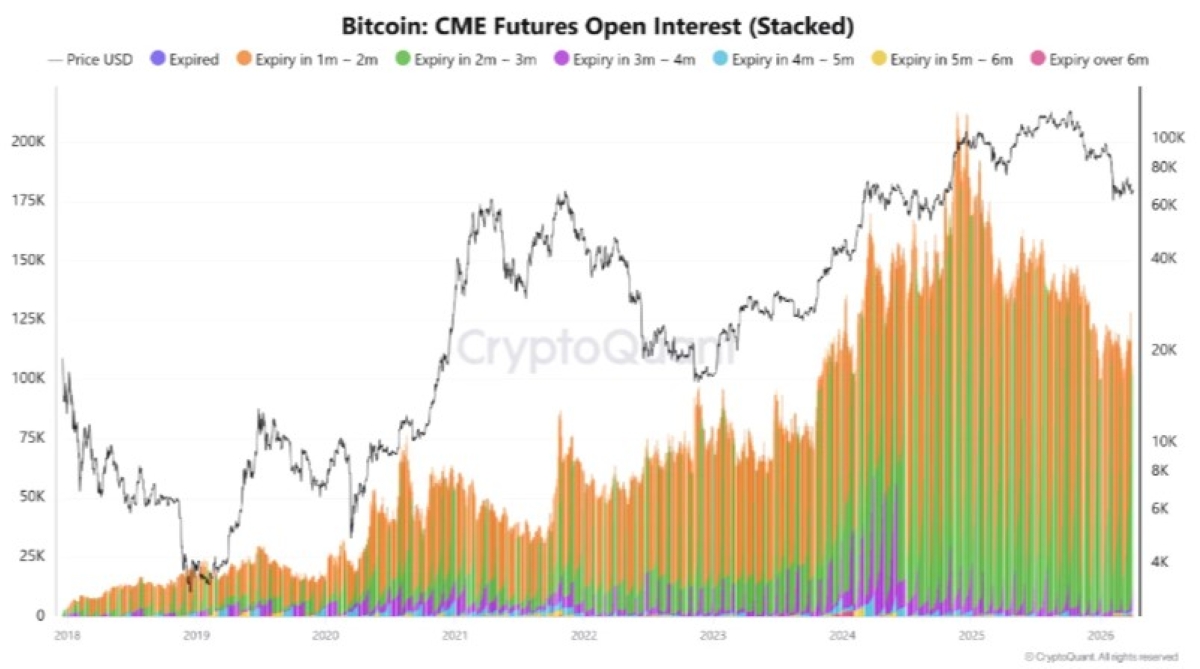
A big part of the concern comes from the futures market, especially on CME. Open interest in CME Bitcoin futures has reached about 18,000 to 20,000 BTC, and much of that is concentrated in short-dated contracts.
A futures contract is a bet on where price will be later, rather than a direct purchase of Bitcoin itself. CME is a large U.S. exchange where institutions trade those contracts. Open interest means the total number of futures positions that are still active and have not been closed yet. Short-dated contracts are positions that expire soon.
That setup matters because it suggests more of Bitcoin price action is being driven by leveraged trading instead of steady spot buying. Spot buying means investors are purchasing actual Bitcoin in the market and holding it. Leverage means traders are using borrowed money to increase the size of a bet.
Leverage can lift gains, but it also raises risk. If price moves the wrong way, losses build faster. Once those losses get too large, exchanges or brokers can force positions to close. That is called liquidation. A liquidation often adds more selling pressure, which can then trigger even more liquidations from other traders. That chain reaction is one reason Bitcoin can fall so fast during stressed markets.
Price discovery is another useful term here. It refers to the process by which the market decides what Bitcoin is worth at any given moment. If price discovery is mostly coming from leveraged futures traders instead of real spot demand, the market can become more unstable.
Why Liquidity Matters So Much
Another warning sign is the broader macro backdrop. The VIX, often called Wall Street’s fear gauge, climbed to around 25. Treasury market spreads widened by 27%, which points to weaker trading conditions and more strain in the financial system.
Liquidity is the key idea running through all of this. Liquidity means how easily money can move through the financial system and in and out of markets. When liquidity is strong, buyers and sellers can trade easily and price moves tend to be smoother. When liquidity weakens, price swings often become sharper and more chaotic.
That is why Bitcoin is being described here as a liquidity-driven asset rather than a safe haven. A safe haven is an asset investors often buy during periods of fear, such as cash or government bonds. Bitcoin, at least in setups like this one, can move the other way because investors may sell it to reduce risk or raise cash.
What Could Happen Next
Under a moderate stress case, Bitcoin could fall from $70,000 to around $50,000, a drop of about 25% to 30%. If ETF outflows continue and spot demand stays weak, the medium-term downside in that framework stretches to $30,000 to $20,000.
Bitcoin ETF outflows mean money is leaving exchange-traded funds that hold Bitcoin. An ETF is a fund that trades on a stock exchange and gives investors exposure without making them buy Bitcoin directly. When money leaves those funds, selling pressure can increase.
There is also a more severe case. If the Hormuz Strait were closed for a longer period, or if the conflict turned into a full-scale regional war, global liquidity could weaken badly. In that kind of setup, with stocks down more than 30% and oil reaching $150 to $200, Bitcoin could fall toward $10,000. That would be a very deep drawdown. A drawdown is the drop from a recent peak to a later low.
For now, the large shock still has not arrived. Bitcoin is holding above $66,000, which gives bulls something to point to. Still, the structure under the market looks shaky. If fear spreads further and leveraged positions start to unwind, pressure can build very quickly.