

Bitcoin and gold often compete for the same role in an investment portfolio. Both have limited supplies, neither relies on a single company, and many people use them as protection against currency weakness.
However, the two assets work very differently. Gold exists as a physical metal, while Bitcoin operates through a global computer network. As a result, Bitcoin can offer features that physical gold cannot easily provide.
Gold has served as money and a store of value for thousands of years. Bitcoin only launched in 2009. Gold therefore has a much longer history, but Bitcoin brings digital speed, easier verification and worldwide access.
Here are 20 reasons why Bitcoin supporters often consider it a stronger form of scarce money.
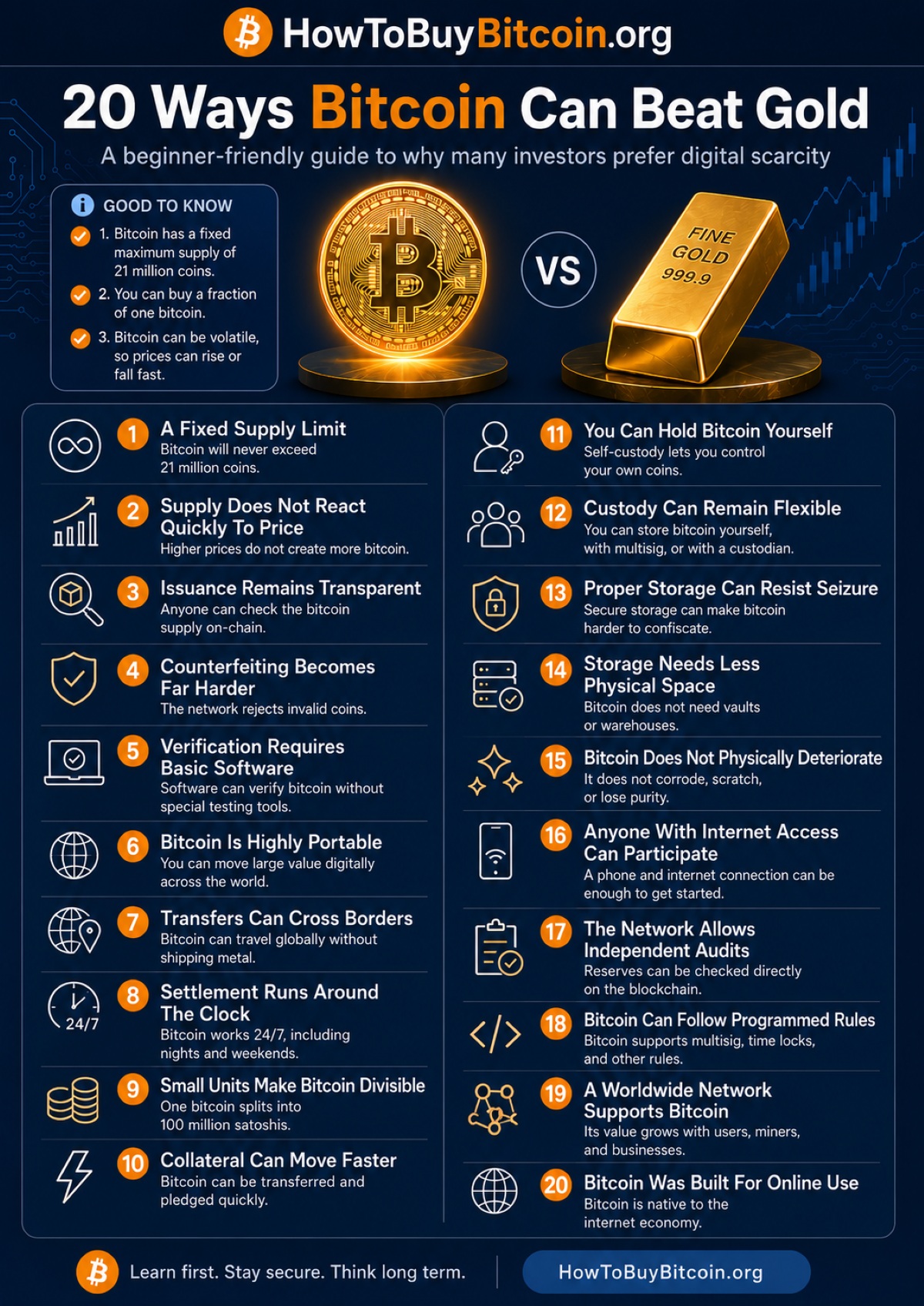
Bitcoin Offers Scarcity You Can Measure
-
A Fixed Supply Limit
Bitcoin has a maximum supply of 21 million coins. Its software controls the rate at which new coins enter circulation.
Gold has no fixed supply ceiling. Mining companies can increase production when higher prices make new projects profitable. Nobody knows exactly how much gold remains underground or how much miners may extract in the future.
Bitcoin gives you a clear supply schedule that anyone can inspect.
-
Supply Does Not React Quickly To Price
Economists use the term supply inelasticity when production does not rise easily after prices increase.
A higher gold price can encourage companies to reopen mines, search for deposits or invest in better extraction methods. Bitcoin works differently. Price changes do not alter its 21 million limit or its programmed issuance schedule.
-
Issuance Remains Transparent
Bitcoin records every new coin on a public ledger called the blockchain. Network participants can check how many coins exist and confirm whether the rules remain intact.
Gold supply estimates depend on reports from miners, refiners, vault operators and governments. Reliable data exists, but investors cannot independently inspect the entire global supply.
-
Counterfeiting Becomes Far Harder
Fake gold bars can contain cheaper metals beneath a gold coating. Buyers may need professional equipment to check purity and weight.
Bitcoin nodes verify coins according to network rules. A valid Bitcoin cannot secretly contain a cheaper material. Fraud can still happen through fake websites or dishonest sellers, but nobody can create a counterfeit coin that the Bitcoin network accepts.
-
Verification Requires Basic Software
You can verify Bitcoin transactions with software and, for deeper control, run your own node.
A node is a computer that checks transactions and enforces Bitcoin rules. Running one lets you confirm payments without relying entirely on an exchange or another company.
Gold testing often needs scales, chemical tests, scanners or trained experts.
Digital Ownership Changes How Money Can Travel
-
Bitcoin Is Highly Portable
Moving a large quantity of gold requires vehicles, security staff, insurance and physical storage arrangements.
Bitcoin can transfer across the internet. A transaction worth $100 and one worth $10 million use the same network, although fees may vary according to network demand rather than payment value.
-
Transfers Can Cross Borders
Bitcoin does not stop operating at national borders. A sender can transfer it to a compatible wallet in another country without shipping anything.
Gold often faces customs declarations, transport costs, security checks and import rules. Governments may also restrict how much physical metal people can carry across borders.
-
Settlement Runs Around The Clock
Banks and traditional payment systems often follow working hours, weekends and public holidays. Bitcoin runs 24 hours a day, seven days a week.
Settlement means completing a payment so the recipient controls the transferred asset. Bitcoin transactions usually receive stronger confirmation as miners add more blocks to the blockchain.
-
Small Units Make Bitcoin Divisible
One Bitcoin divides into 100 million satoshis. A satoshi represents the smallest standard unit on the Bitcoin network.
You do not need enough money to buy a full coin. Exchanges often let you purchase a small amount, such as $10 or $50 worth.
Gold also divides into smaller quantities, but tiny physical pieces become harder to weigh, verify and trade efficiently.
-
Collateral Can Move Faster
Borrowers sometimes use valuable assets as collateral for loans. Physical gold must usually sit in an approved vault before a lender accepts it.
Bitcoin can transfer to an agreed wallet within minutes. However, crypto lending carries major risks, including liquidation, company failure and loss of access to funds.
Beginners should research any lending service carefully before depositing Bitcoin.
Ownership Can Take Several Forms
-
You Can Hold Bitcoin Yourself
Bitcoin gives you the option of self custody, which means controlling the private keys that authorize transactions.
A private key acts like a secret digital credential. Anyone who obtains it may gain control over the related coins. You therefore need secure backups and careful handling.
Owning physical gold also gives direct control, but storing a large amount safely can require a secure vault.
-
Custody Can Remain Flexible
You can store Bitcoin through several arrangements:
- A personal hardware wallet
- A mobile or desktop wallet
- A regulated custodian
- A multisignature wallet
A multisignature wallet requires approval from more than one key before funds can leave. Families, businesses and long term holders may use the structure to reduce reliance on one device or one person.
-
Proper Storage Can Resist Seizure
A person who controls Bitcoin private keys and protects them carefully may make confiscation difficult.
However, Bitcoin does not provide automatic immunity from the law. Authorities can seize devices, order custodians to freeze accounts or compel people to surrender assets where local law permits.
Gold also faces seizure risk, especially when stored with a bank, dealer or vault provider.
-
Storage Needs Less Physical Space
Bitcoin does not require warehouses, armored transport or metal insurance. A hardware wallet can protect access credentials in a small device.
In reality, the coins do not sit inside the wallet. Bitcoin remains recorded on the blockchain. The wallet stores the keys that let you control it.
Gold needs secure physical space, especially at higher values.
-
Bitcoin Does Not Physically Deteriorate
Gold resists corrosion well, which helps explain its long history as a store of value. Still, bars and coins can suffer scratches, damage, contamination or purity disputes.
Bitcoin has no physical form to scratch or corrode. As long as the network operates and you retain valid access to your keys, each unit remains identical under the protocol.
Bitcoin Works As Internet Based Money
-
Anyone With Internet Access Can Participate
A person with a smartphone and internet connection can create a Bitcoin wallet. No bank account is technically required to receive Bitcoin.
Buying it can involve identity checks, depending on the exchange and local rules. Access therefore varies between countries and service providers.
Even so, Bitcoin often gives people a direct route into a worldwide financial network.
-
The Network Allows Independent Audits
Companies, governments and individuals can prove control of Bitcoin addresses through cryptographic signatures. They can also publish wallet addresses so others can inspect balances on the blockchain.
An exchange can use proof of reserves to show that it controls certain coins. However, reserves alone do not reveal all company debts. A complete assessment also needs information about liabilities.
Gold investors often rely on vault reports and third party audits.
-
Bitcoin Can Follow Programmed Rules
Bitcoin transactions can include conditions through scripts. Users can create time locked payments, multisignature arrangements and inheritance plans.
A time lock prevents coins from moving until a chosen time or block height.
Gold cannot enforce such conditions by itself. Lawyers, banks, vault companies and contracts must handle comparable arrangements.
-
A Worldwide Network Supports Bitcoin
Bitcoin becomes more useful as more people, businesses, developers, miners and payment providers support it.
Economists call the effect a network effect. A communication or payment network can gain value when more participants join and improve its usefulness.
Gold also benefits from wide acceptance, but Bitcoin combines scarcity with a payment and settlement network.
-
Bitcoin Was Built For Online Use
Gold developed in a physical economy. Bitcoin operates natively on the internet.
You can send it to a digital wallet, integrate it with software and verify transactions without physically inspecting an item. Such features make Bitcoin easier to use in online commerce and digital financial services.
Does Bitcoin Really Beat Gold?
The answer depends on what you need.
Bitcoin offers easier transport, transparent issuance, precise divisibility and direct digital ownership. Gold offers a much longer record, lower dependence on electricity and internet access, and widespread recognition among central banks and traditional investors.
Bitcoin also carries greater price volatility. Its value can rise or fall sharply within a short period. Lost private keys may also mean permanent loss, while mistakes involving an exchange or wallet can prove difficult to reverse.
Rather than treating the comparison as an automatic choice, consider the role each asset might play. Gold provides physical scarcity with centuries of financial history. Bitcoin provides verifiable digital scarcity through an open network.
For new buyers, education should come before investment. Learn how wallets, private keys, transaction fees and exchange security work. Start with an amount you can afford to lose, and never share a wallet seed phrase with anyone.